
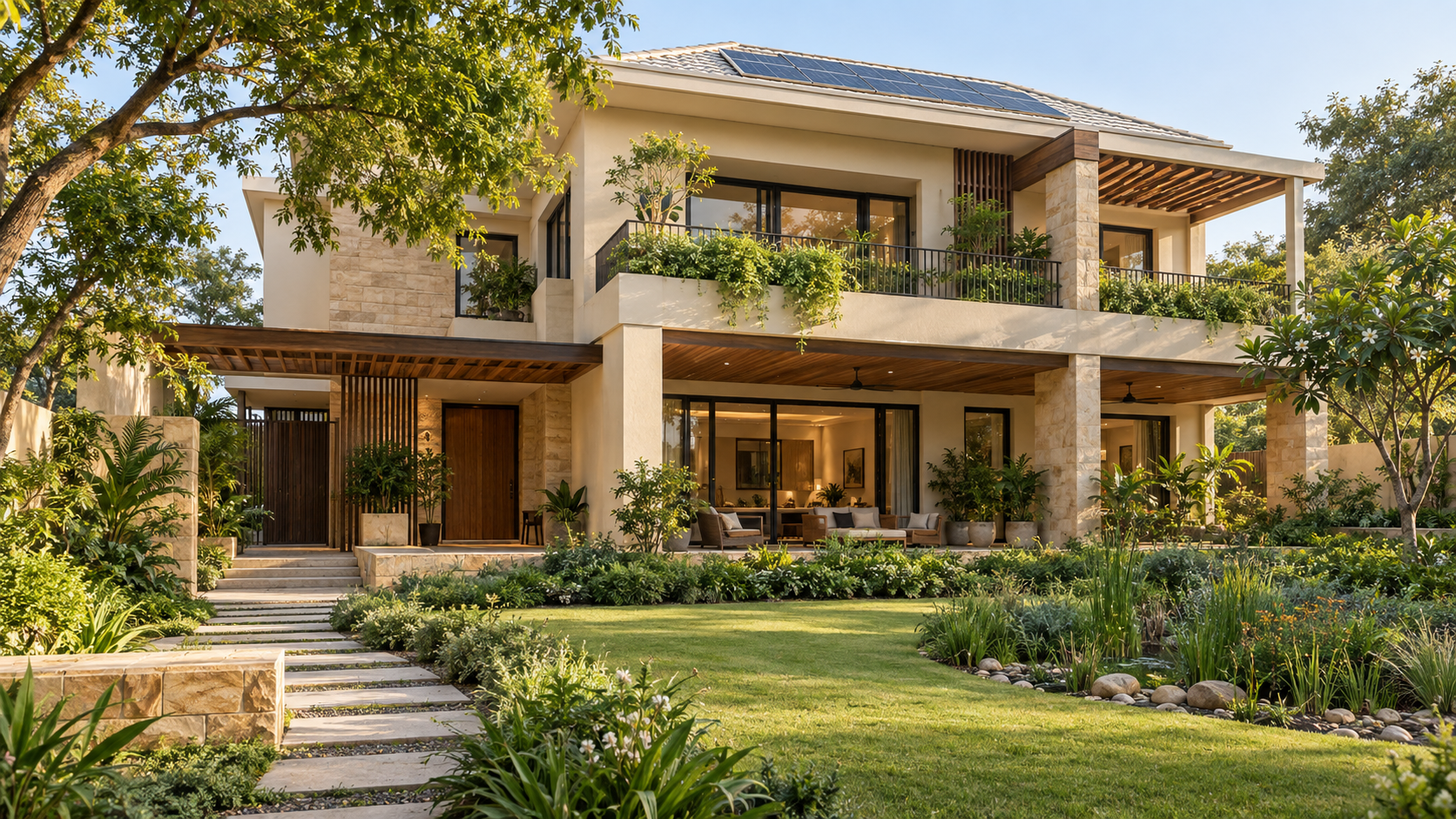
Green Luxury Villas in Lucknow: What Makes Them Different—and Are They Worth the Investment?
Discover how a climate-responsive green luxury villa differs from conventional construction—and why energy efficiency, water conservation, healthier indoor air and intelligent MEP planning make it a practical investment for Lucknow’s climate.
For many homeowners, a luxury villa means impressive elevation, spacious rooms, premium marble, designer lighting, modern kitchens and elegant interiors. These features certainly add beauty and prestige—but the meaning of luxury is changing.
Today, genuine luxury is also about thermal comfort, healthier indoor air, natural light, lower energy consumption, water security and a home that remains efficient for decades.
This is where the concept of a green luxury villa becomes important.
A green villa is not simply a conventional house with solar panels installed on its roof. It is designed as an integrated system in which architecture, materials, landscaping, electrical services, plumbing and air-conditioning work together to improve comfort while reducing the consumption of energy and water.
For a city such as Lucknow—with intense summers, humid monsoons and comparatively cold winters—this approach is both relevant and practical.
What Is a Green Luxury Villa?
A green luxury villa is a climate-responsive home that uses natural resources intelligently and minimises unnecessary energy and water consumption without compromising comfort, appearance or lifestyle.
Its planning usually considers:
- The direction of the sun
- Prevailing winds and natural ventilation
- Heat entering through the roof, walls and windows
- Daylight without excessive glare
- Energy-efficient air-conditioning and electrical systems
- Water conservation and rainwater harvesting
- Solar-energy generation
- Indoor air quality
- Environmentally responsible materials
- Long-term operating and maintenance costs
The objective is not to make a villa look “technical” or industrial. A well-designed green villa can appear every bit as elegant and luxurious as a conventional villa—while performing substantially better.
How Is It Different from a Conventional Villa?
A conventional villa is commonly planned around room requirements, elevation, finishes and the maximum permissible built-up area. Environmental performance is often considered only after the architectural design has been completed.
A green villa begins differently.
The architect and engineering team study the plot orientation, sunlight, shading, building envelope, ventilation, water management and energy demand from the initial planning stage.
1. Orientation and Planning
In a conventional villa, rooms and windows may be positioned primarily for appearance or convenience.
In a green villa, the building is oriented to control unwanted solar heat while making intelligent use of daylight and seasonal ventilation. Wherever the plot permits, exposure to the harsh western sun is reduced, while balconies, service areas, staircases or landscaped buffers can protect frequently occupied rooms.
2. Roof and Wall Performance
The roof is one of the largest sources of summer heat gain in a villa.
A conventional RCC roof may receive waterproofing and finishing but little consideration for thermal performance. A green villa can use roof insulation, reflective finishes, shaded terraces, ventilated roof arrangements or appropriate landscape elements to reduce heat transfer.
External walls may incorporate cavity construction, AAC blocks, insulation or other thermally efficient systems selected according to the design and budget.
3. Windows and Glazing
Large glass windows are frequently associated with modern luxury. However, excessive unshaded glazing—particularly on the west and southwest—can turn a beautiful villa into a greenhouse during a Lucknow summer.
A green villa uses glazing selectively. Window size, glass specification, orientation and external shading are considered together.
Deep chajjas, recessed windows, pergolas, vertical fins and balconies can often control heat more effectively than expensive glass alone.
4. Air-Conditioning and Ventilation
A conventional villa may use air-conditioners selected mainly according to room area.
In a green villa, cooling demand is reduced through better architecture before the equipment is selected. Air-conditioning can then be properly sized, zoned and controlled according to actual occupancy.
Energy-efficient inverter systems, insulated refrigerant piping, correctly designed ductwork, ceiling fans and intelligent thermostats can improve comfort while reducing consumption.
Lucknow’s humid monsoon period also requires careful moisture control. Natural ventilation is useful when outdoor conditions are favourable, but during humid weather the villa may need controlled fresh air, filtration and dehumidification rather than simply opening every window.
5. Water Management
A conventional villa generally uses treated fresh water for most requirements and sends wastewater away without reuse.
A green villa can incorporate:
- Low-flow plumbing fixtures
- Dual-flush cisterns
- Rainwater harvesting
- Groundwater recharge
- Leak-detection provisions
- Efficient landscape irrigation
- Greywater or treated-water reuse, where practical
- Native and comparatively low-water plants
These measures are particularly valuable as cities face increasing pressure on groundwater and municipal infrastructure.
6. Energy and Smart Controls
Solar panels are an important feature, but they should not be the first step.
The correct approach is to reduce the villa’s energy demand through design and efficient equipment, and then meet part of the remaining requirement through renewable energy.
A well-planned green villa may include:
- Rooftop solar photovoltaic panels
- Solar or heat-pump water heating
- Energy-efficient lighting and appliances
- Motion and daylight sensors
- Smart air-conditioning controls
- Energy monitoring
- Provision for battery backup
- Electric-vehicle charging infrastructure
Home automation becomes genuinely useful when it improves efficiency and comfort—not when it merely adds more gadgets.
Is a Green Villa Feasible in Lucknow?
Yes, it is both technically feasible and climatically appropriate.
Lucknow experiences more than one type of weather during the year. Summers can be extremely hot, the monsoon brings high humidity and winter nights can be quite cool.
Therefore, a green villa in Lucknow must not be designed only for summer cooling. It requires a balanced building envelope that limits excessive summer heat, manages monsoon moisture and maintains reasonable comfort during winter.
Suitable strategies may include:
- Careful solar orientation
- Strong protection from western sunlight
- Insulated or reflective roofs
- Thermally efficient walls
- Shaded and appropriately specified windows
- Cross-ventilation for suitable seasons
- Controlled ventilation during humid weather
- Efficient, zoned air-conditioning
- Solar-energy generation
- Rainwater harvesting
- Climate-appropriate landscaping
India’s Bureau of Energy Efficiency developed the Eco Niwas Samhita to improve the energy performance of residential buildings. It addresses heat gain through the building envelope while encouraging adequate natural ventilation and daylight.
Green-building frameworks such as GRIHA similarly evaluate sustainability across planning, construction and building operation rather than judging a building through one product or feature.
Does a Green Villa Cost More?
Some green-building measures require additional initial investment, but many do not.
Correct orientation, sensible window placement, efficient space planning and external shading are design decisions. When incorporated at the beginning, they may involve little additional cost.
Other measures—such as high-performance glazing, roof insulation, solar power, advanced ventilation, water recycling and smart controls—can increase the construction budget. However, the additional cost depends entirely on the selected specifications and the discipline with which they are integrated.
Not every imported product marketed as “green” is necessary. Locally available materials, climate-responsive architecture and straightforward passive-design measures can often provide greater value.
The sensible order of investment is:
1. Orientation, shading and architectural planning
2. Roof, walls, windows and the building envelope
3. Efficient air-conditioning, electrical and plumbing services
4. Solar power and smart controls
5. Green-building certification, where required
A villa should first reduce its need for energy and then install technology to meet the remaining demand.
Is It Worth the Investment?
For homeowners who plan to occupy their villa for several years, a properly designed green villa can be a worthwhile investment.
Its value should not be measured only through the payback period of solar panels. The benefits may include:
- Greater thermal comfort
- More uniform indoor temperatures
- Reduced air-conditioning demand
- Better control of monsoon humidity
- Healthier indoor air
- Improved natural daylight
- Lower electricity and water consumption
- Reduced dependence on external utilities
- Better long-term property differentiation
- A more resilient and future-ready home
The Bureau of Energy Efficiency has reported that residential building-envelope measures have the potential to reduce cooling-energy consumption compared with typical construction. Actual savings in an individual villa will depend on its orientation, construction quality, equipment, occupancy and operating habits.
It is therefore important to avoid unrealistic promises. A poorly designed villa does not become green merely by adding solar panels, and an expensive collection of “eco-friendly” products cannot compensate for weak architectural planning.
Green Design and Luxury Can Work Together
There is a misconception that sustainable homes must look rustic, minimal or less luxurious.
In reality, green design does not prescribe a particular architectural style. A villa can be classical, contemporary, modern or culturally inspired while still being environmentally responsible.
High ceilings, courtyards, shaded verandahs, landscaped transitions, filtered daylight and carefully framed views can simultaneously improve aesthetics and environmental performance.
The best sustainability features are often almost invisible. The homeowner simply experiences a villa that feels cooler, quieter, fresher and more comfortable.
The Aurevia Perspective
At Aurevia Luxury Villas, we believe that true luxury extends beyond decorative finishes.
A thoughtfully designed villa should respond to its location, provide year-round comfort, conserve valuable resources and remain efficient throughout its life. Architecture, interiors, electrical systems, plumbing, air-conditioning, solar energy and landscaping must be coordinated from the earliest design stage.
For Lucknow, a green luxury villa is neither an impractical experiment nor merely an environmental statement. When designed correctly from the beginning, it can become a more comfortable, resilient and financially sensible form of luxury living.
Planning a luxury villa in Lucknow?
Speak with Aurevia Luxury Villas about integrating climate-responsive architecture, efficient MEP services, water conservation and renewable energy into your home from the concept stage.
Aurevia Luxury Villas
Bespoke Architecture, Interiors and Sustainable Villa Planning
aurevialuxuryvillas.com
ashwini@aurevialuxuryvillas.com
WhatsApp: 7838981189