Energy-Efficient MEP Systems Every Luxury Villa Should Consider
Luxury in a modern villa is not defined only by visible finishes, spacious rooms or smart controls. It also depends on the unseen mechanical, electrical and plumbing systems that maintain comfort, indoor air quality, reliable power and efficient water use throughout the year.
In Lucknow’s climate—with intense summers, a humid monsoon and cool winters—poorly coordinated MEP services can cause high utility bills, uneven cooling, water wastage, noise and repeated maintenance. Planning these systems together during the design stage creates a villa that is more comfortable, economical, resilient and easier to operate over its lifetime.
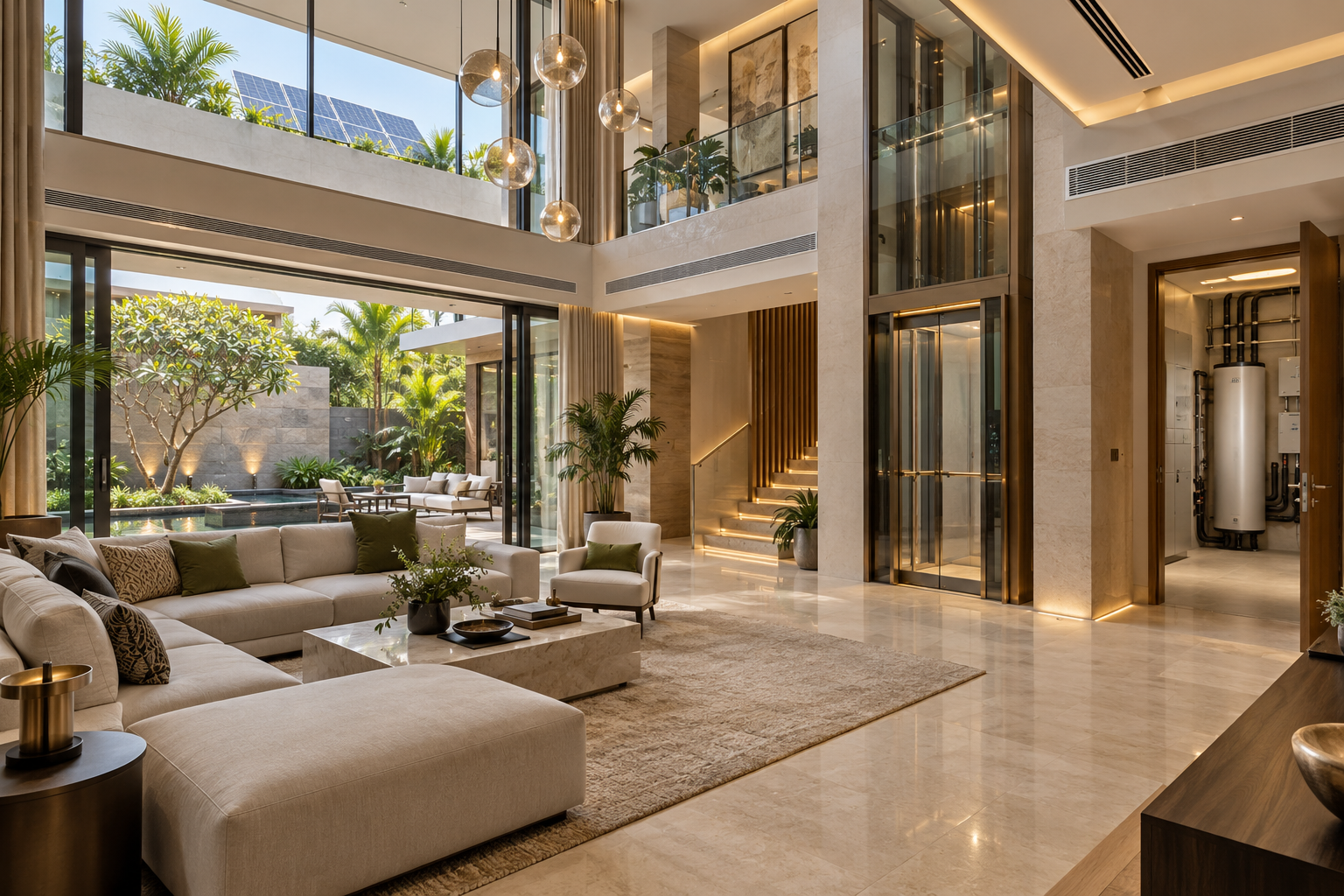
Energy-efficient luxury villa with integrated cooling, solar power, efficient lighting and organised building services. AI-generated concept image for design inspiration; not a completed project photograph.
Plan MEP as One Integrated System
Mechanical, electrical and plumbing services should be planned together with the architecture and structure—not fitted into leftover spaces after the layout is finalised. Early coordination determines plant-room locations, service shafts, ceiling depths, equipment access, drainage routes and future maintenance requirements.
Prepare coordinated MEP drawings and a realistic load schedule before construction begins. This helps prevent clashes between ducts, pipes, beams, lighting and false ceilings while reducing costly changes during execution. It also ensures that every system is correctly sized for the villa’s actual requirements rather than selected through guesswork.
Design Cooling Around Actual Heat Loads
Air-conditioning is usually the largest energy consumer in a luxury villa. Avoid choosing equipment only by room area or by increasing capacity “for safety.” Oversized units may cool quickly but cycle frequently, control humidity poorly and consume more power.
Ask the HVAC consultant to calculate room-by-room heat loads after considering orientation, glazing, insulation, occupancy, lighting and equipment. High-efficiency inverter split, ducted or VRF systems can then be selected according to the villa’s size, zoning and usage pattern.
Divide the villa into independently controlled zones so that unoccupied bedrooms, guest areas and formal spaces do not require continuous cooling. Keep outdoor units in ventilated, serviceable locations and provide proper condensate drainage, vibration isolation and access for filter cleaning and repairs.
Provide Fresh Air and Humidity Control
Cooling alone does not guarantee healthy indoor air. Airtight windows, powerful kitchen exhausts and continuously closed rooms can create stale air, odours, excess carbon dioxide and unwanted pressure differences.
Provide planned fresh-air ventilation for occupied rooms and effective exhaust for kitchens, bathrooms, utility areas and basements. Energy-recovery ventilation may be considered where operating patterns and project scale justify it. During the monsoon, proper humidity control helps reduce condensation, mould and the discomfort of a cold but clammy interior.
Use accessible, high-quality filters suited to local dust conditions, and locate fresh-air intakes away from roads, generator exhausts, plumbing vents and outdoor-unit discharge. Indoor-air-quality sensors can monitor parameters such as carbon dioxide, particulate matter, temperature and humidity, but they should support—not replace—good ventilation design and regular maintenance.
Build a Safe and Future-Ready Electrical System
Begin with a detailed electrical load schedule covering air-conditioning, kitchens, water heaters, pumps, lifts, electric-vehicle charging, landscape services, security systems and other major equipment. Apply realistic diversity so that the sanctioned load, transformer or generator is neither inadequate nor unnecessarily oversized.
Provide separate, clearly labelled circuits for lighting, sockets and major appliances, with accessible distribution boards arranged by floor or functional zone. Use correctly rated cables and protective devices, reliable earthing, residual-current protection, surge protection and lightning protection as required by the project and applicable standards.
Reserve spare ways in distribution boards, suitable conduits and capacity for future solar power, battery storage, automation, additional air-conditioning and EV charging. A well-documented single-line diagram and circuit schedule will make future testing, fault-finding and expansion considerably easier.
Use Efficient Lighting and Sensible Controls
Specify efficient LED luminaires with appropriate output, colour temperature, colour quality and glare control instead of judging fixtures only by wattage. Coordinate lighting with daylight, furniture, artwork and ceiling design so that fewer, well-positioned fittings can provide both ambience and useful illumination.
Use layered lighting circuits for ambient, task, accent and decorative lighting. Occupancy sensors are useful in stores, dressing rooms, passages and utility areas, while daylight sensors and timers can reduce unnecessary operation of exterior and landscape lighting.
Scene controls can simplify daily use, but essential lights should remain operable through familiar wall switches. Select replaceable, locally serviceable drivers and fittings wherever practical; an efficient system loses its value if a minor component failure requires replacing an entire decorative fixture.
Plan Solar Power and Backup Around Priorities
A rooftop solar system can offset daytime consumption from air-conditioning, pumps, appliances and common-area loads. Its capacity should be based on usable, shadow-free roof area, structural suitability, electricity-consumption patterns and the applicable utility requirements—not simply the largest system that fits.
Designate safe, ventilated and serviceable locations for inverters, protection equipment and any future battery storage. Coordinate cable routes, earthing, lightning protection, isolation and monitoring from the beginning, even if installation will be completed later.
Separate essential and non-essential loads before sizing backup power. Security, internet, selected lighting, refrigeration, water pumps, medical equipment and lift-rescue functions may require priority, while high-demand appliances can remain excluded. This approach reduces generator or battery size, fuel use, noise and operating cost while maintaining essential comfort and safety.
Design Plumbing for Efficiency and Easy Maintenance
Estimate water demand realistically and divide the system into clearly identified cold-water, hot-water, flushing, irrigation and treated-water networks where applicable. Select efficient fixtures that reduce consumption without compromising the experience expected in a luxury villa.
Use correctly sized pipes, pressure zones and efficient variable-speed pumps where suitable. Excessive pressure wastes water, creates noise and shortens the life of fittings, while insufficient pressure produces an equally poor result. Provide accessible isolation valves so that one bathroom or zone can be repaired without shutting down the entire house.
Plan drainage slopes, traps, vents, cleanouts and access points carefully before construction. Install leak sensors near tanks, pumps, water heaters, kitchens and concealed service areas, and consider automatic shut-off for critical locations. Separate meters or monitoring for major uses can reveal abnormal consumption before a hidden leak causes serious damage.
Reduce the Energy and Water Used for Hot Water
Hot-water systems should be sized according to actual occupancy, bathroom usage, kitchen demand and travel distance between the heater and fixtures. Oversized storage systems waste energy, while poorly located heaters cause residents to discard large quantities of water while waiting for it to become hot.
Consider solar water heating or efficient heat-pump water heaters where roof space, climate, maintenance support and usage patterns make them practical. Insulate hot-water pipes and storage tanks, and use controlled recirculation only where long pipe runs justify it. Recirculation pumps should operate through timers, occupancy logic or demand controls rather than continuously.
Capture Rainwater and Reuse Water Responsibly
Rainwater harvesting should be integrated with roof drainage, filtration, storage or groundwater-recharge arrangements according to site conditions and local requirements. Keep the system accessible for cleaning before and during the monsoon.
Where a treatment system is practical, treated wastewater can support flushing or landscape irrigation through a completely separate, clearly marked network. Reuse systems must be designed for water quality, odour control, safe storage and dependable maintenance; installing complicated equipment without an operating plan rarely produces lasting savings.
Use Smart Monitoring Without Creating Dependency
A simple energy-monitoring system can show total consumption and separate major loads such as cooling, hot water, pumps, EV charging and landscape services. Water-level, pump-status and leak alerts can also help identify abnormal operation before it becomes expensive.
Automation should make the villa easier—not harder—to operate. Choose systems with clear interfaces, local technical support and manual control for essential functions. Avoid locking basic lighting, cooling or water services behind a single app, internet connection or proprietary controller.
Commission, Document and Maintain Every System
Energy-efficient equipment cannot compensate for poor installation. Before handover, test electrical protection, earthing, water pressure, drainage, pump operation, HVAC performance, controls, backup changeover and every safety interlock under realistic conditions.
Obtain approved drawings, test reports, warranties, equipment schedules, operating instructions and maintenance contacts in both digital and printed form. Label valves, panels, circuits and service routes clearly, and establish a preventive-maintenance calendar for filters, pumps, tanks, solar equipment, batteries, generators and water-treatment systems.
Commissioning and documentation are not administrative extras. They convert coordinated design and quality equipment into reliable, measurable performance throughout the villa’s life.
Energy-Efficient Villa MEP Checklist
• Complete coordinated architectural, structural and MEP drawings before construction.
• Calculate room-by-room cooling loads and divide the villa into practical HVAC zones.
• Provide planned fresh air, exhaust, filtration and humidity control.
• Prepare a realistic electrical load schedule and clearly separate essential loads.
• Include proper earthing, residual-current protection, surge protection and lightning protection.
• Use efficient LED lighting with daylight, occupancy and timer controls where appropriate.
• Reserve roof space, conduits and electrical capacity for solar power and future batteries.
• Provide correctly sized water pipes, pressure zones, pumps and accessible isolation valves.
• Insulate hot-water systems and control any recirculation pump intelligently.
• Integrate rainwater harvesting and practical treated-water reuse where suitable.
• Provide energy, water-level, pump-status and leak monitoring without eliminating manual control.
• Test, label and document every system, and prepare a preventive-maintenance schedule before handover.
A High-Performance Villa Begins Behind the Finishes
The most successful energy-efficient villa is not defined by one premium product. It results from correctly sized systems, coordinated design, quality installation, simple controls and disciplined maintenance working together.
These decisions are most valuable when made before construction, while equipment spaces, service routes, electrical capacity and water networks can still be integrated without compromising the architecture.
Planning a new villa or upgrading an existing home in Lucknow? Aurevia Luxury Villas can help develop a coordinated MEP brief that balances comfort, efficiency, resilience and long-term serviceability.
WhatsApp: 7838981189
Email: ashwini@aurevialuxuryvillas.com
Website: www.aurevialuxuryvillas.com
Final system capacities and specifications should be confirmed by qualified architects, engineers and specialist consultants for the specific project.