Reliable Supply, Comfortable Pressure and Water You Can Trust
The Intelligent Villa · Chapter 06
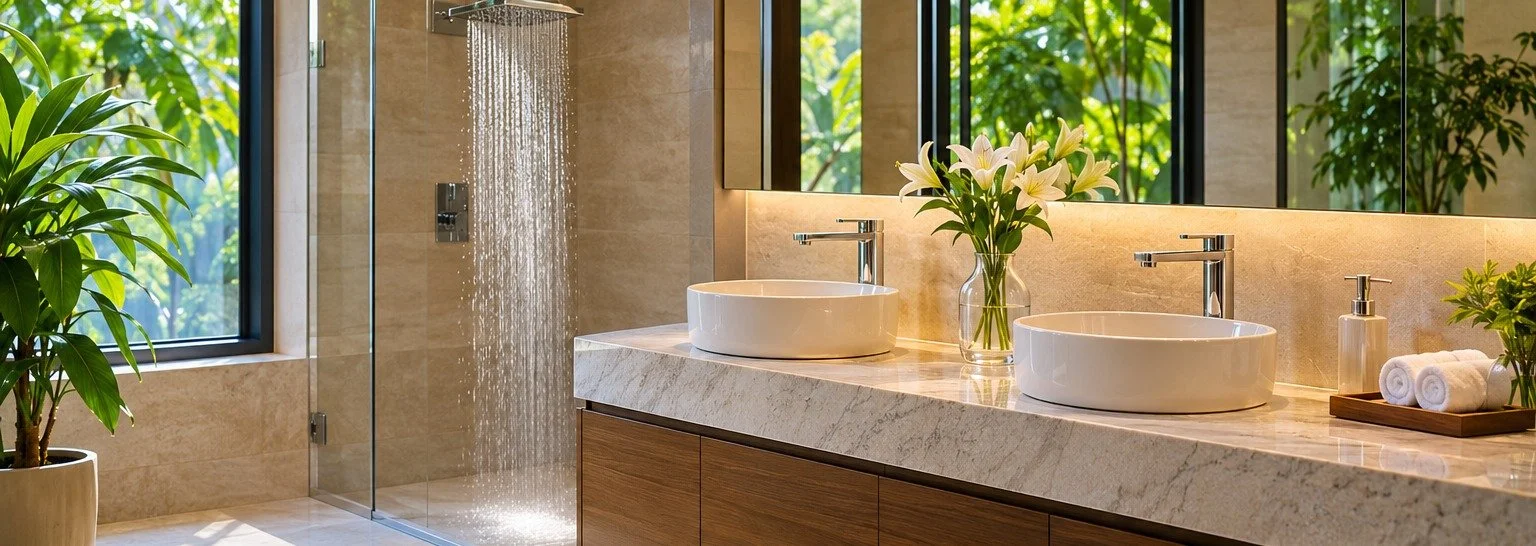
Dependable water supply brings everyday comfort to every floor of a villa.
1. When water is taken for granted
Imagine an ordinary morning in a three-storey family villa.
Someone is preparing breakfast in the kitchen. A family member is taking a shower on the first floor. Another person is getting ready in a bathroom on the second floor.
The washing machine has started its cycle.
Then the water pressure drops.
The shower becomes a weak trickle. The kitchen tap slows down. Someone calls out to ask whether the overhead tank is empty.
A few minutes later, the family discovers that the water pump has stopped working.
It is a small incident, but it affects several people at once.
Now imagine the same home with a carefully planned water system.
The family understands where its water comes from, how it is stored and how it reaches different floors. The pumps and controls are accessible. Important valves are identifiable, and the system has been designed with realistic household demand in mind.
A breakdown may still occur, but investigating and managing it becomes easier.
Good water planning is not simply about having enough water. It is about dependable supply, suitable pressure, water quality and practical maintenance.
2. Understand your water source
Before choosing pumps, tanks or filtration equipment, understand the source of water available to your property.
In a city such as Lucknow, a villa may receive municipal water, use an approved groundwater source, depend partly on tanker deliveries or have a combination of arrangements.
The availability, reliability and quality of these sources can vary.
Municipal supply may not always be available at the same pressure throughout the day.
Groundwater, where extraction is legally permitted, may contain dissolved minerals or other constituents that affect its suitability for drinking and domestic use.
Tanker water may vary depending on the supplier and source.
The homeowner should establish which supplies are permitted, how dependable they are and whether their quality has been appropriately assessed.
Do not assume that clear-looking water is safe to drink.
Equally, do not assume that every groundwater source requires the same treatment.
The correct starting point is to understand the actual source and its characteristics.
3. Plan water storage sensibly
Water storage helps a household manage interruptions or variations in incoming supply.
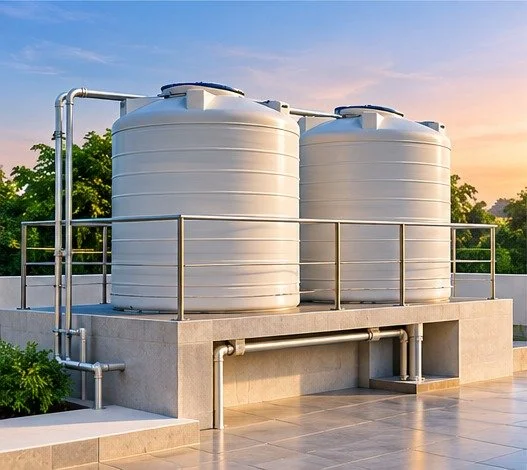
Protected water storage should allow safe inspection and cleaning.
Many villas use an underground storage tank, an overhead tank or a combination of the two.
But storage should not be selected only by choosing the largest tank that fits.
The family should consider the number of occupants, bathrooms, kitchens, likely water use and reliability of incoming supply.
The plumbing designer should determine appropriate capacity and the arrangement for filling, overflow, ventilation and distribution.
Excessive storage can also create problems if water remains unused for long periods.
Tanks should be designed and installed to limit contamination, with suitable covers, screened openings where required and arrangements for cleaning.
They should be accessible for inspection without creating unsafe working conditions.
Underground tanks need careful attention to protection from external contamination and surrounding drainage conditions.
Overhead tanks require suitable structural support and safe access.
A tank that cannot be inspected or cleaned conveniently is not a good long-term solution, however neatly it is concealed.
4. Water pressure across floors
Water pressure affects everyday comfort.
A shower should provide a satisfactory flow. A kitchen tap should work predictably. Washing machines, water heaters and other appliances should receive water within their specified operating conditions.
In a multistorey villa, achieving this consistently requires planning.
An overhead tank can supply water by gravity, but pressure generally depends on the height difference between the water level and the outlet, along with losses in the piping.
Upper-floor fixtures close to the tank may therefore receive less pressure than fixtures on lower floors.
A booster pump or pressure-management system may help where gravity supply is insufficient.
However, increasing pressure indiscriminately is not the answer.
Excessive pressure can strain fittings, valves, appliances and pipe connections.
The plumbing designer should consider the complete system, including pipe routes, simultaneous demand, fixture requirements and safe pressure limits.
Comfortable water pressure is not the highest possible pressure. It is pressure that is suitable and consistent for the intended use.
5. Choosing pumps and controls
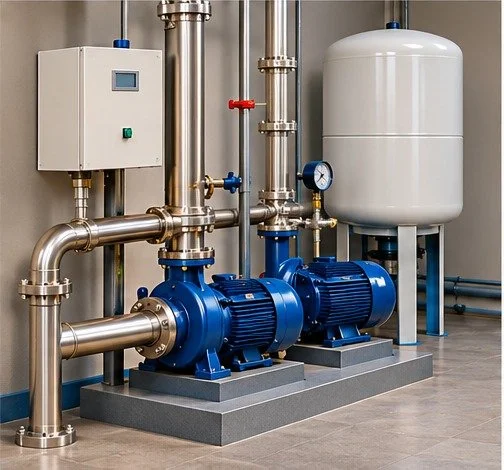
Accessible pumps and pressure controls support dependable water delivery.
Water pumps are important components in many villas.
They may transfer water from an underground tank to an overhead tank or maintain pressure in a distribution system.
A pump should be selected for the actual duty it must perform.
The homeowner does not need to calculate pump head, flow rates or motor characteristics.
But the plumbing designer should consider these factors along with the number of fixtures, building height and expected simultaneous use.
Controls may include level sensors, pressure controls and protective devices.
Suitable protection against dry running can help prevent damage when water is unavailable.
Some systems use variable-speed pumping to adjust delivery according to demand.
These arrangements may offer convenience, but they also introduce electronic components that require appropriate service support.
Noise and vibration should be considered when locating pumps.
A pump placed beside a bedroom wall or directly beneath a quiet living area may create avoidable disturbance.
Ask where the pump will be installed, how it will be isolated and how a technician will remove it when necessary.
Local service availability and spare parts are important considerations.
6. Separate water uses where appropriate
Not every household use requires water of identical quality.
Drinking and cooking water must meet appropriate potable-water requirements.
Water used for bathing, washing and cleaning should also be suitable for its intended purpose.
Gardening or certain other uses may have different requirements, subject to applicable regulations and safe system design.
In some villas, separate treatment arrangements may be appropriate.
For example, a point-of-use drinking-water purifier may serve the kitchen while another treatment system addresses hardness affecting selected household appliances.
A carefully designed non-potable supply may be considered for appropriate uses where permitted.
However, separating supplies adds complexity.
Non-potable water must never be allowed to contaminate drinking-water plumbing through incorrect connections or backflow.
Where multiple water systems are proposed, the designer should provide clear identification, suitable separation and appropriate protective arrangements.
For many households, a simpler system may be more practical.
The decision should reflect actual water quality, usage and maintenance capacity.
7. Filtration and water treatment
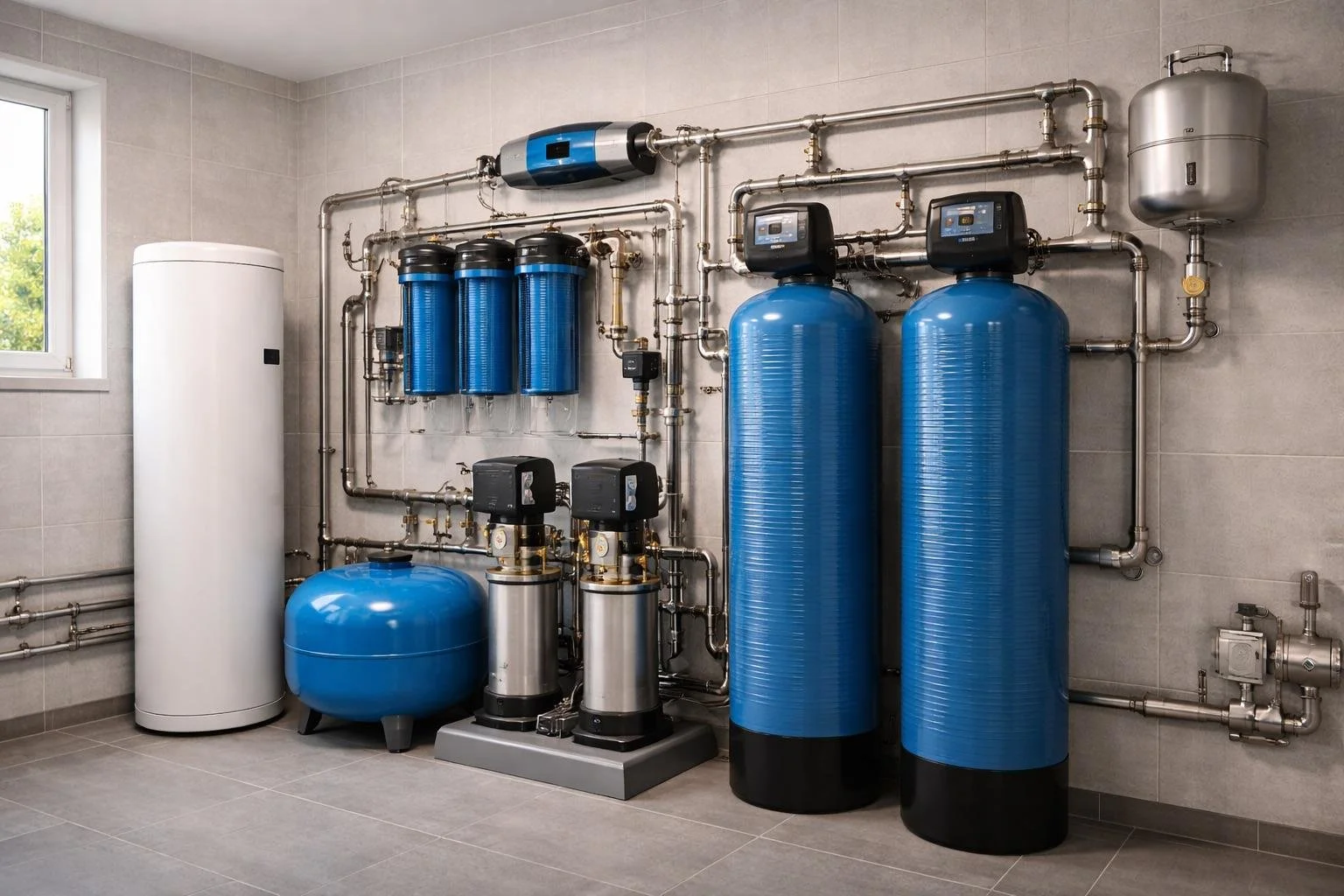
A thoughtfully designed water-treatment system addresses specific water-quality concerns while allowing convenient inspection, servicing and filter replacement.
Water-treatment products are often advertised as universal solutions.
In reality, different treatment methods address different problems.
A sediment filter may help remove certain suspended particles.
A water softener can reduce hardness caused by calcium and magnesium, but it does not by itself make microbiologically unsafe water potable.
Reverse osmosis, commonly called RO, can reduce various dissolved constituents when correctly selected and maintained. It also produces reject water and may be unnecessary where the source water already meets drinking-water requirements.
Ultraviolet treatment can help inactivate susceptible microorganisms when the water and system meet the treatment conditions, but it does not remove dissolved salts and provides no lasting disinfectant residual.
Activated-carbon filters may improve certain taste and odour characteristics and reduce selected contaminants, depending on the product.
No single treatment method solves every water-quality problem.
Treatment equipment should be chosen after appropriate testing and professional assessment.
The homeowner should also ask how often filters, membranes, lamps or other components require servicing or replacement.
A treatment system that is not maintained can become ineffective or create additional hygiene concerns.
8. Test water before selecting equipment

Water testing helps identify suitable treatment for the actual source.
A water-quality test provides information that appearance, smell and taste alone cannot establish.
Depending on the source and intended use, testing may need to consider microbiological contamination, hardness, dissolved solids, iron, nitrate, fluoride or other locally relevant parameters.
The appropriate testing programme should be selected with a competent laboratory or water-quality professional.
For drinking water in India, the applicable BIS drinking-water specification, IS 10500, is an important reference for evaluating suitability, alongside relevant public-health and regulatory requirements.
A basic handheld dissolved-solids meter is not a complete water-safety test.
Water with a low dissolved-solids reading may still contain harmful microorganisms or other contaminants.
Similarly, a high dissolved-solids reading does not identify which substances are present.
If the water source changes, or if there is reason to suspect contamination, reassessment may be necessary.
The family should retain test reports and treatment-equipment records as part of the home's services manual.
9. Safe and practical distribution
Once water enters the property, it must travel through pipes, valves and fittings to different rooms.
Much of this network will eventually be concealed.
The plumbing layout should therefore be coordinated before walls, floors and ceilings are finished.
Suitable pipe materials, jointing methods and installation practices should be selected by the plumbing professional.
Water pipes should be routed to reduce unnecessary exposure to damage, contamination and excessive heat.
Important valves should be accessible and clearly identifiable.
For example, a local valve serving a bathroom or fixture may allow maintenance without interrupting water to the entire villa.
Separate isolation for pumps, treatment equipment and other serviceable components may also be useful.
Concealed joints should be minimised where practical and installed according to the selected system's requirements.
Required pressure testing should be completed before concealing the work.
Photographs and accurate as-built drawings can make future repairs easier.
The principle established in Chapter 2 applies here:
Concealed plumbing should be carefully planned, but the components that need servicing should not become inaccessible.
10. Avoiding stagnation and contamination
Water quality can deteriorate after it enters the property.
A clean source does not guarantee clean water at every tap if storage and plumbing are poorly maintained.
Tanks may accumulate sediment. Damaged covers or unsuitable openings may allow insects, dust or other contamination to enter.
Water that remains stagnant in unused branches of plumbing can also create hygiene concerns.
Infrequently used guest bathrooms, terrace outlets and seasonal facilities deserve attention.
The plumbing design should avoid unnecessary dead-end branches and provide arrangements appropriate to the intended usage.
Backflow prevention is another important consideration.
Under certain conditions, contaminated water can flow backwards through an unsuitable connection and enter a clean-water system.
Appropriate protective devices and physical separation should be provided wherever required.
Drinking-water and non-potable-water systems must not be casually interconnected.
Tank cleaning, flushing procedures and other hygiene measures should follow professional advice and applicable requirements.
If contamination is suspected, do not rely on appearance or taste. Seek appropriate testing and guidance before using the water for drinking or cooking.
11. Water during power cuts
Imagine that the electricity fails during a hot summer afternoon.
Your villa has plenty of water stored underground, but the pressure pump has stopped.
Will the bathrooms still receive water?
The answer depends on the plumbing arrangement.
A properly designed overhead-tank system may continue supplying some fixtures by gravity, although pressure may be limited at certain levels.
A system that depends entirely on an electrically operated pressure pump may lose normal water delivery when electricity fails.
If the household needs continued pumped supply, suitable backup power may be considered.
However, pumps have starting and operating requirements that must be assessed by the electrical designer.
A normal household inverter should not be assumed suitable without checking the actual pump and system characteristics.
The family should also consider whether an alternative gravity-fed arrangement or another practical provision would be more dependable.
Chapter 5 explains how essential electrical loads should be prioritised.
For water supply, the important question is:
What happens at the taps when the pump has no electricity?
The answer should be understood before the villa is occupied.
12. When pressure falls or water stops
Suppose the shower on the second floor suddenly develops poor flow.
The family may initially assume that the pump is faulty.
But several different conditions can produce similar symptoms.
The incoming supply may be interrupted. A tank may be empty. A filter may be blocked. A valve may be partly closed. A pump control may have failed.
Alternatively, the problem may affect only one fixture because of a local blockage or faulty fitting.
The homeowner can make limited, safe observations.
Is water available at other taps?
Are other floors affected?
Has the normal electricity supply failed?
Is there a visible leak?
Is a pump displaying a fault indication?
These observations can help the service technician.
However, the homeowner should not open electrical pump equipment, dismantle pressure systems or attempt repairs beyond safe routine operations described by the manufacturer.
A persistent pressure problem should be investigated by a qualified plumbing or pump-service professional.
Clearly labelled valves, accessible equipment and accurate drawings can reduce the time needed to identify the fault.
13. Plan, Maintain, Repair, Replace
PLAN
Establish the water source, expected demand, storage requirements, distribution arrangement and appropriate treatment. Coordinate plumbing routes, pumps, isolation valves and service access before construction finishes.
MAINTAIN
Follow suitable tank inspection and cleaning schedules. Service pumps, filters, softeners and drinking-water treatment equipment according to manufacturer recommendations and actual water conditions. Arrange water-quality reassessment when appropriate.
REPAIR
Provide accessible valves and documented pipe routes so qualified technicians can isolate affected sections, locate faults and carry out repairs with minimal unnecessary disruption.
REPLACE
Allow enough space to remove pumps, filters, pressure vessels and other serviceable equipment. Select products with practical spare-parts and service support, and retain installation information for future upgrades.
Water equipment has a working life.
Pumps may eventually need replacement. Filter cartridges require periodic changing. Pressure controls and valves can fail. Water-treatment equipment may become unsuitable if the source water changes.
These are normal possibilities over the life of a home.
The objective is not to eliminate every future repair.
It is to make necessary maintenance and replacement straightforward, safe and reasonably economical.
14. Ready reference — Water supply and quality planning checklist
Review these questions with your architect, plumbing designer and water-treatment specialist before approving the water-services layout.
Water planning review
Source, storage and water quality
Have we confirmed the available and permitted water sources?
Have we assessed suitable storage capacity, tank hygiene and cleaning access?
Has appropriate water testing been planned before selecting treatment equipment?
Pressure and distribution
Will water pressure be suitable across all floors and important fixtures?
Are pumps, controls and pressure arrangements appropriate for actual demand?
Are important isolation valves, plumbing routes and service equipment accessible?
Reliability and maintenance
Do we understand what happens to water supply during a power cut?
Are tank cleaning, pump servicing and filter replacement arrangements practical?
Will as-built drawings, water-test reports, equipment manuals and service records be provided?
15. A final thought
Water is one of the simplest comforts to take for granted.
We expect it to arrive whenever we open a tap, at a comfortable pressure and in a condition suitable for its intended use.
Achieving that reliability requires more than a large tank or a powerful pump.
It requires an understanding of the source, thoughtful storage, appropriate treatment, sensible distribution and regular maintenance.
A well-planned water system should also be manageable when something goes wrong.
The family should know where important valves are located, whom to contact for servicing and what arrangements remain available during a power interruption.
The best water system is not the one with the most equipment. It is the one that delivers dependable, appropriate-quality water with the least unnecessary complexity.
Coming next — Chapter 7: Hot Water and Bathing. Choosing between centralised hot-water generation, individual geysers and practical hybrid arrangements.