Before planning a smart home, understand what makes your family comfortable.

1. The morning your home should be ready for
Imagine an ordinary weekday morning in your new villa.
The first sunlight enters the bedrooms. Someone is preparing breakfast. Another family member is getting ready for work. A child is looking for a schoolbag, while an elderly parent prepares for a warm shower.
The kitchen is busy. Water is flowing. Lights and fans are working. The bedrooms remain comfortable, and someone has already joined an online meeting.
Nobody is thinking about the systems that make these things possible.
That is how a well-planned home should feel.
Now imagine that the electricity suddenly goes off.
The lights go out. The water pump stops. The internet connection disappears. Someone wonders whether the lift can be used. Another person searches for a torch.
Would your home continue to function comfortably? Would essential lights remain available? Would stored water be sufficient? Could the family still communicate and move safely?
These are not questions about luxury gadgets. They are questions about everyday living.
The intelligence of a home is revealed not only when everything works, but also when something goes wrong.
2. Begin with your family's way of living
A home should reflect the people who live in it.
A couple building their first house may have different priorities from a family with young children. A multigenerational household may need accessible bedrooms, easy-to-operate controls and dependable services throughout the day.
Some families entertain frequently. Others prefer quiet evenings. Some work from home, while others travel regularly and need reassurance that their property remains secure.
Before deciding which technology to install, discuss how your family spends a normal day.
Consider where people gather, when bathrooms are busiest, which rooms need cooling for long periods and whether anyone needs uninterrupted internet access.
Also think about the people who help maintain the household. A gardener, cleaner, electrician or plumber should be able to carry out necessary work without disturbing private family spaces unnecessarily.
A good architect can translate these everyday needs into sensible planning decisions.
The most useful starting point is not a product brochure. It is a conversation about how you want to live.
3. Seven essentials that make a home comfortable
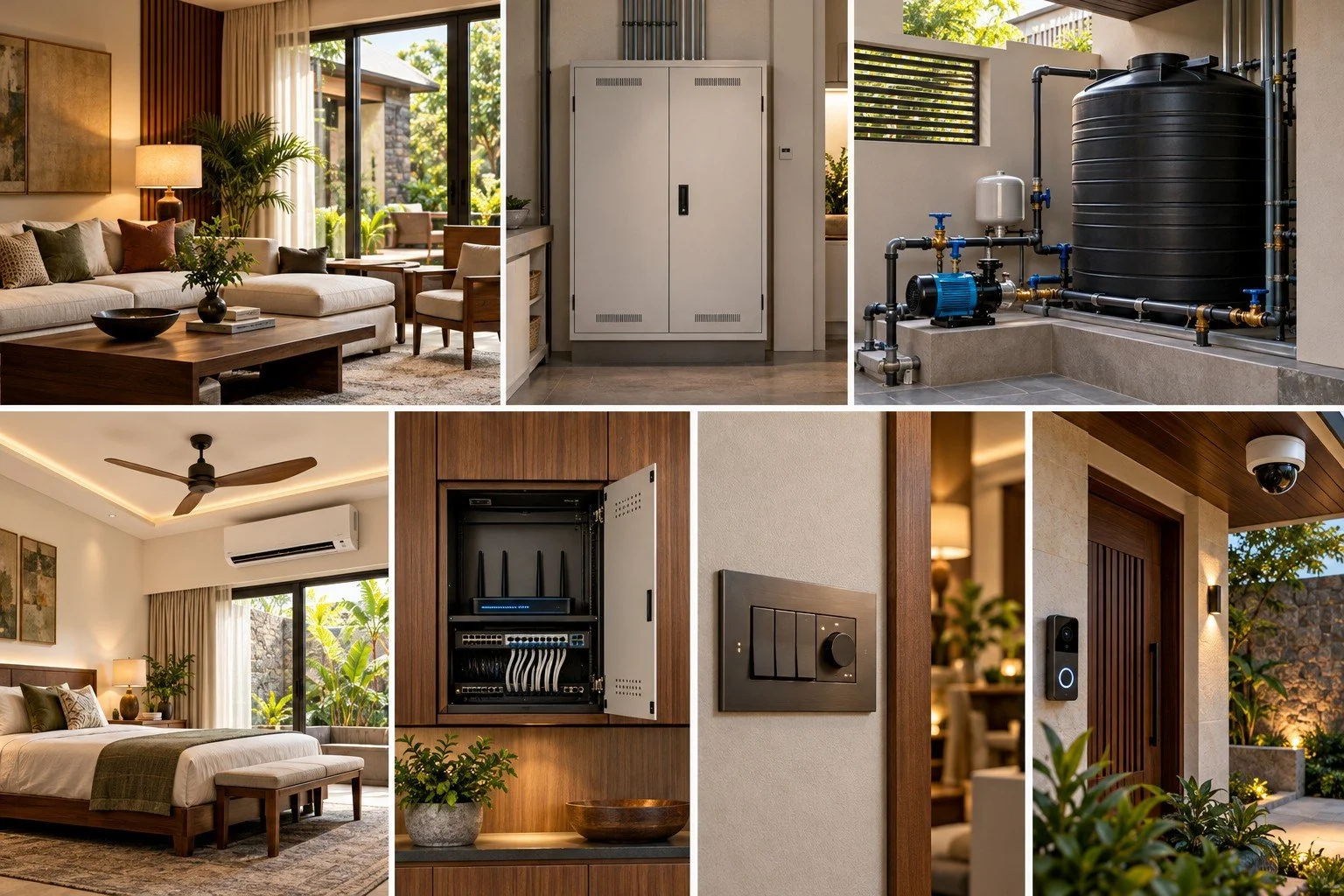
Light — comfort throughout the day
Daylight makes rooms welcoming, while carefully positioned artificial lighting supports reading, cooking, movement and relaxation. Plan convenient switches, suitable night lighting and access for replacing failed fixtures.
Electricity — dependable and safe
Electricity supports almost every household activity. Plan safe distribution, appropriate backup, clear circuit identification and accessible electrical panels. A qualified electrician should be able to isolate and repair an affected circuit safely.
Water — reliable when needed
Water storage, pumps, pressure, filtration and drainage should work together. A leaking tap or pipe should not require shutting down the entire home unnecessarily. Accessible valves and maintainable equipment are essential.
Air — pleasant rooms in every season
Cooling alone does not guarantee comfort. Fresh air, ventilation, humidity, dust and cooking smells also matter. Air-conditioning filters, drains and outdoor units need practical cleaning and servicing access.
Connectivity — dependable communication
Internet and Wi-Fi are everyday necessities for many households. Plan network coverage, accessible cabling and suitable locations for routers and other equipment. Devices should be replaceable as technology changes.
Automation — useful simplicity
Automated outdoor lights, selected lighting scenes and scheduled equipment can make life easier. But basic functions should remain straightforward to operate, including when the internet or automation controller fails.
Electronic security — reassurance and privacy
Video doorbells, cameras, alarms and access controls can improve security. Plan reliable power arrangements, maintenance access, privacy-conscious coverage and safe operation during emergencies.
These seven essentials are closely connected. A security system may depend on electricity and connectivity. A water pump depends on power. Cooling equipment needs electrical supply, drainage and regular maintenance.
Planning them together helps prevent inconvenient surprises later.
4. A lesson from a leaking bathroom pipe
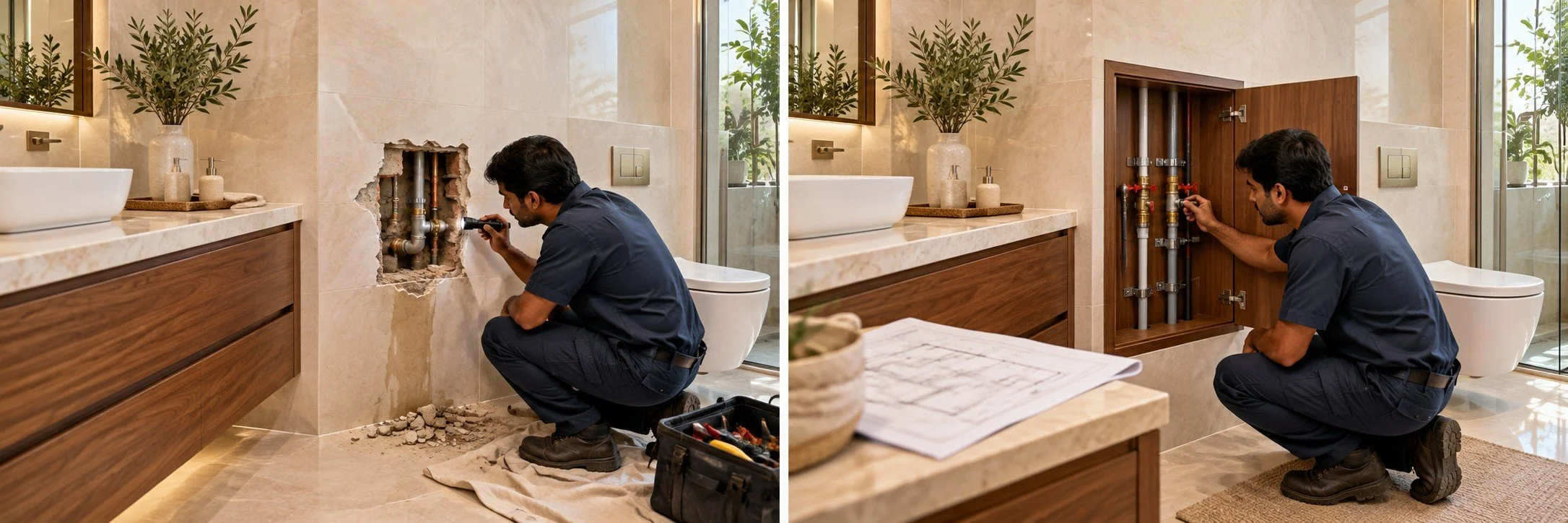
Consider two newly completed villas.
Both have attractive bathrooms, expensive fittings and beautifully finished walls.
After a few years, a concealed water connection begins leaking.
In the first villa, nobody knows exactly where the pipe runs. There is no conveniently accessible local isolation valve. The plumber must investigate behind the finished surfaces, and water supply to several rooms may need to be interrupted.
In the second villa, the plumbing routes are documented. Appropriate isolation valves are accessible, and serviceable connections have been planned sensibly. The plumber can identify and isolate the affected area more quickly.
Neither design can guarantee that a leak will never occur.
But the second home is better prepared to deal with it.
This principle applies throughout the villa.
An air conditioner must be cleaned and eventually repaired. A water pump may need replacement. Electrical protective devices require inspection. Network equipment becomes outdated. Security cameras and automation controllers can fail.
A beautiful installation is incomplete if nobody has considered how it will be maintained.
5. Plan, Maintain, Repair, Replace
This is the proposed recurring feature for every chapter in The Intelligent Villa.
PLAN — Before construction
Decide what the system must do, where its equipment will go, and how it will connect with the rest of the house. Provide suitable access, service routes and isolation controls.
MAINTAIN — During everyday use
Follow the manufacturer's maintenance guidance. Arrange regular inspection, cleaning and servicing where needed. Keep equipment accessible and maintain service records.
REPAIR — When something fails
Know whom to contact and how to make the affected system safe. Qualified technicians should have access to the necessary controls, documentation and equipment without unnecessary demolition.
REPLACE — When equipment reaches the end of its life
Allow for future removal, replacement and upgrades. Avoid arrangements that trap serviceable equipment permanently behind decorative finishes.
This four-part approach is not intended to turn homeowners into technicians.
Its purpose is to help them ask better questions before construction and avoid avoidable difficulties later.
6. Make the home simple for everyone
An intelligent villa should not require every family member to understand technology.
A visitor should be able to find a light switch. An elderly parent should not need a mobile application to operate an essential room light. A household worker should know how to report a problem without interfering with unfamiliar controls.
The home should also remain manageable when systems fail.
If the internet stops working, essential lights and safe access should still be available through suitable independent or manual arrangements.
If an automation controller becomes defective, it should be possible to investigate the fault without unnecessarily disabling unrelated services.
If a pump needs repair, suitable isolation should allow a qualified technician to work safely.
For security doors and access systems, emergency exit and fire-safety requirements must always take priority over convenience.
Good technology should simplify the home, not make its occupants dependent on complicated controls.
7. Decide what must be built now and what can wait
During construction, it is easy to feel pressured to purchase every available smart-home feature.
That is rarely necessary.
Some decisions affect the permanent structure of the building. Others concern devices that can be installed or upgraded later.
| Plan carefully before construction | Often possible to add later |
|---|---|
| Electrical circuits, capacity and distribution | Selected smart switches and lighting scenes |
| Plumbing routes and isolation valves | Water-use monitoring devices |
| Cooling equipment locations and drainage | Compatible control upgrades |
| Internet cabling and access-point locations | Additional wireless devices |
| Security wiring and equipment provisions | Extra compatible security equipment |
| Maintenance access and replacement routes | Future equipment upgrades |
The second column assumes suitable infrastructure and compatibility have already been provided.
The objective is to invest first in the parts of the home that are expensive or disruptive to change.
8. Think beyond moving-in day
The first few months in a new villa are exciting. Everything is fresh, clean and new.
But the home should remain comfortable ten or twenty years later.
Your family may grow. Your parents may need easier movement. A room may change its purpose. A new appliance may require additional electrical capacity.
Some equipment will need replacement long before the building itself reaches the end of its useful life.
Thoughtful planning allows for these changes.
Keep important service routes accessible. Avoid unnecessarily trapping equipment behind permanent finishes. Ask for drawings showing concealed installations. Maintain a record of warranties, manuals and service contacts.
At handover, the homeowner should know where the main electrical isolation controls are, how water can be shut off, where essential equipment is installed and whom to contact in an emergency.
For electrical or other hazardous systems, isolation and repairs must be performed by appropriately qualified people. Homeowners should not open live panels or attempt unsafe repairs.
A home is easier to manage when its essential information is available before an emergency occurs.
9. Ready reference — Before approving your villa plans
Discuss these questions with your family, architect and relevant service consultants.
Homeowner planning checklist
Everyday comfort
- Have we discussed our family's daily routines and future needs?
- Have we considered light, electricity, water and air in each important room?
- Have we planned dependable internet and appropriate electronic security?
Dependability
- Have we identified essential services that need backup?
- Will basic household functions remain usable during technology failures?
- Are important manual and isolation controls appropriately planned?
Long-term care
- Can technicians reach major equipment safely?
- Can faulty equipment be inspected, repaired and replaced?
- Have we planned to receive service drawings, manuals and warranties?
10. The home you will appreciate every day
A truly intelligent villa does not need to announce its intelligence.
You experience it when the right light is available, when water flows reliably, when rooms remain comfortable and when the internet works where you need it.
You appreciate it even more when something goes wrong and the problem can be addressed without unnecessary disruption.
The best home is not necessarily the one with the most technology.
It is the one that is easy to live in, practical to maintain, straightforward to repair and capable of adapting to tomorrow.
That is where intelligent planning begins.
Coming next — Chapter 2: Hidden Infrastructure. The important decisions that disappear behind walls, ceilings and floors.