Comfortable Showers, Sensible Energy Use and Dependable Hot Water
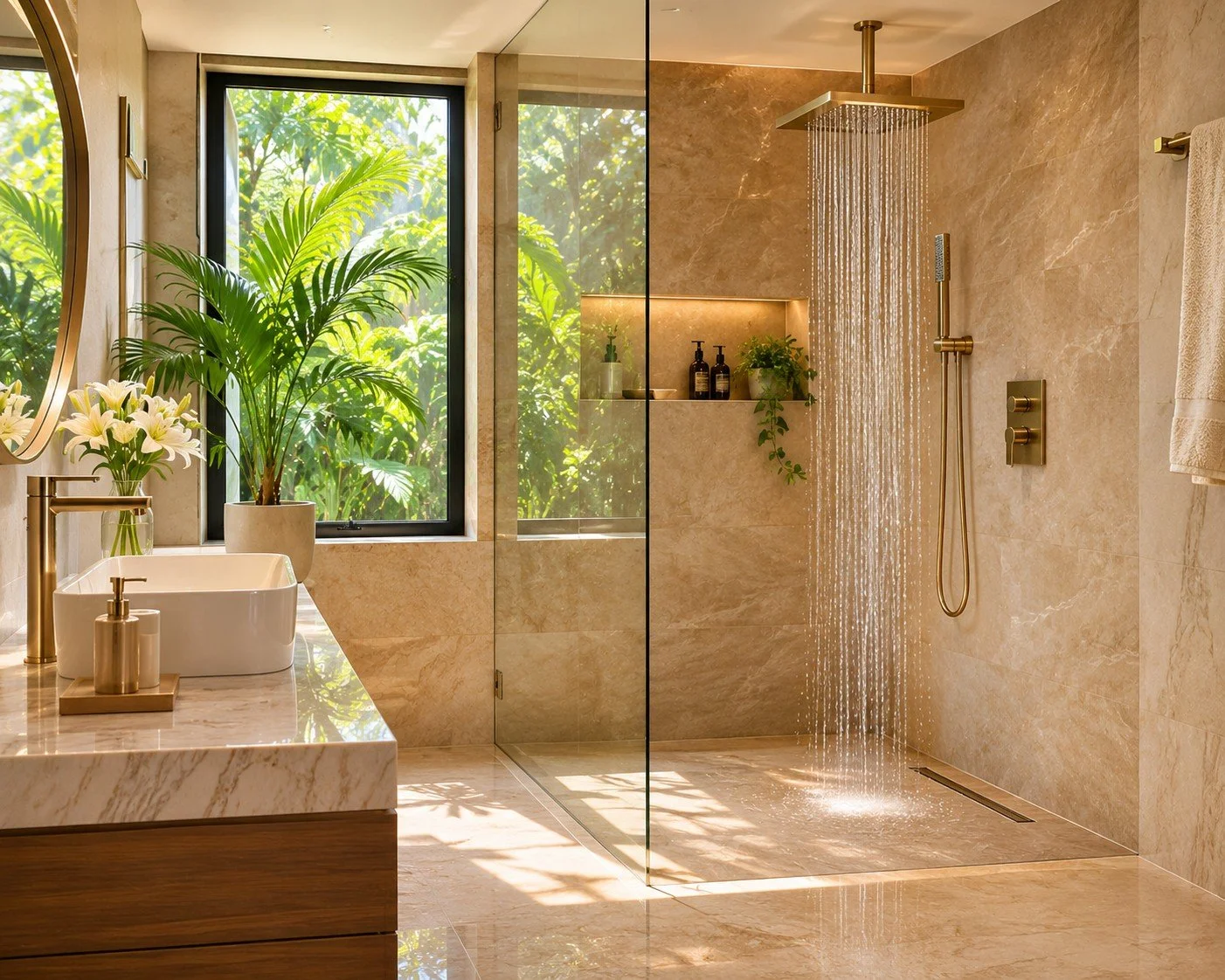
1. The morning hot-water problem
Imagine a winter morning in a three-storey family villa.
Someone is taking a shower on the first floor. Another family member has just entered the bathroom on the second floor. A third person is washing dishes in the kitchen.
The first shower begins comfortably.
Then the water turns cooler.
Someone calls out to ask whether another bathroom has started using hot water.
A few minutes later, the second shower also becomes uncomfortable.
The family may have installed attractive shower fittings and expensive bathroom finishes, but the hot-water system was never properly planned for simultaneous use.
Now imagine a different arrangement.
The family has considered how many bathrooms may be used together, how far they are from the heating equipment and what temperature and pressure each fixture requires.
The hot-water system has been selected accordingly.
It may use individual geysers, a centralised system or a combination of both.
The particular technology matters less than whether it suits the family's daily routine.
Good hot-water planning begins with how people bathe, not with the equipment catalogue.
2. Start with your family's bathing habits
Before selecting a water heater, consider how the household actually uses hot water.
How many people live in the villa?
How many bathrooms are used during the morning?
Do family members prefer quick showers or longer bathing routines?
Are there rain showers, hand showers or bathtubs?
Will guests regularly use bathrooms on different floors?
A villa with six bathrooms does not necessarily need to supply all six simultaneously.
But a family with several people leaving home at the same time may have substantial morning demand.
The plumbing and hot-water designer should assess the likely simultaneous use rather than simply count the bathrooms.
The type of fixtures also matters.
A large rain shower or bathtub may require a different hot-water arrangement from a conventional shower.
The homeowner does not need to calculate heating capacity or storage volume personally.
The important task is to describe the family's expectations accurately.
A system should be designed for realistic peak demand without unnecessary oversizing.
3. Individual electric geysers
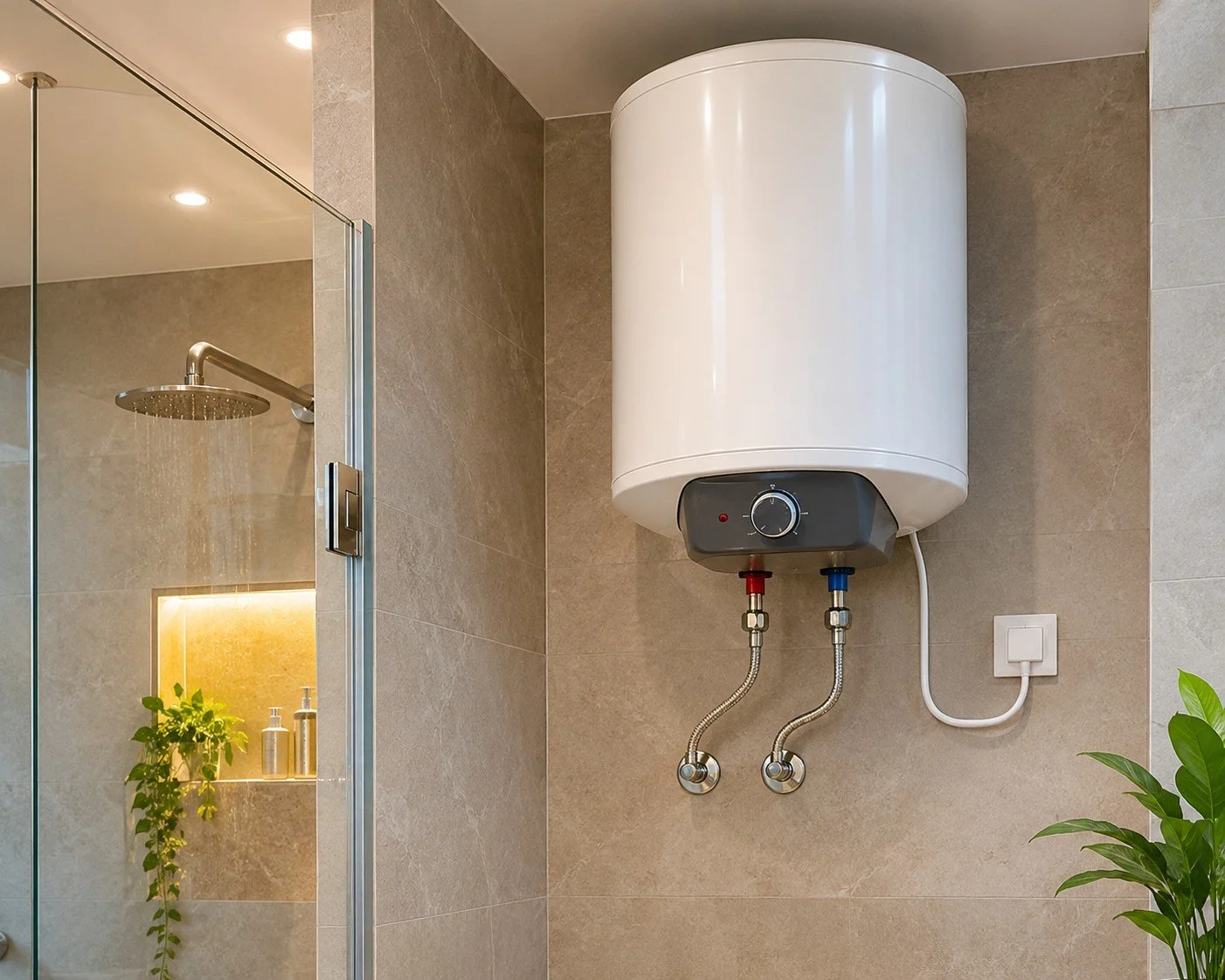
Individual electric geysers are familiar to many Indian households.
A storage geyser heats water in a tank and supplies it to nearby fixtures.
An instantaneous electric water heater heats water as it flows, subject to its rated capacity and the available electrical supply.
Both arrangements have appropriate applications, but they should not be treated as interchangeable.
A major advantage of individual geysers is local control.
A bathroom can have its own heater, allowing the family to operate it according to need.
A fault in one heater may not affect the other bathrooms.
Replacement may also be relatively straightforward if the installation provides proper access.
However, individual geysers introduce several considerations.
Multiple heaters require suitable electrical circuits and protection.
Each unit occupies space and may need periodic servicing.
Storage capacity can become a limitation during long or repeated showers.
Instantaneous units may demand substantial electrical power to deliver the desired flow and temperature rise.
For a multistorey villa, the total electrical demand from several heaters operating together must be assessed by the electrical designer.
Individual geysers can be an excellent solution when the number, location and usage of bathrooms make them practical.
They should not be selected merely because they are familiar.
4. Centralised hot-water systems
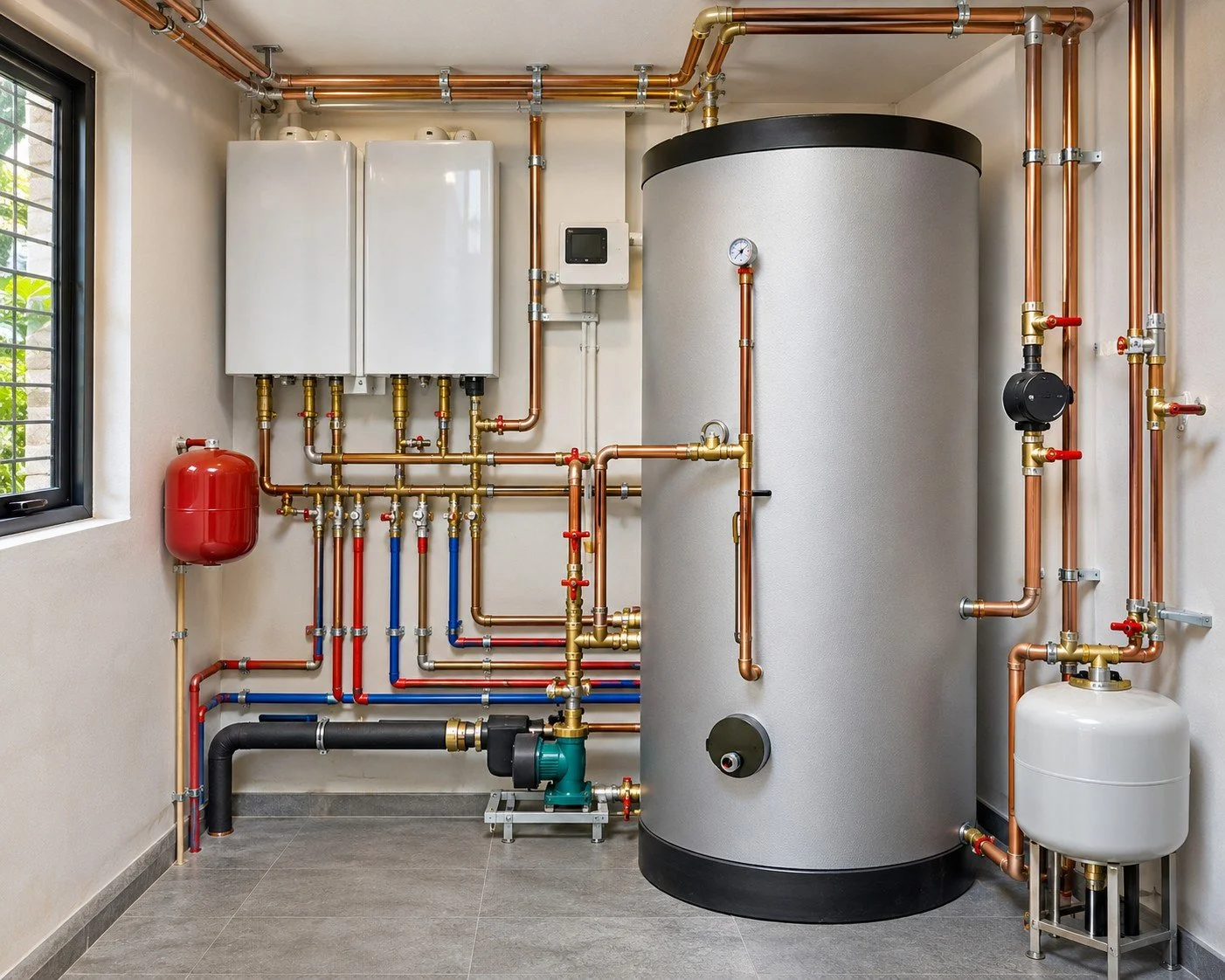
A centralised system generates hot water at one main location and distributes it to several bathrooms or other fixtures.
Depending on the design, it may use a storage tank, heat pump, electric heating, solar-assisted heating or another suitable source.
Centralised systems can be attractive for villas with several bathrooms and substantial simultaneous demand.
They may reduce the need for separate heaters in every bathroom and allow heating equipment to be concentrated in a service area.
However, centralisation introduces additional planning requirements.
Hot water must travel through pipes to distant fixtures.
Heat can be lost along these routes.
The system may require circulation equipment, insulation, controls and suitable protection against excessive temperature or pressure.
A failure in the central heating arrangement may affect multiple bathrooms unless an appropriate backup or alternative has been planned.
Centralised systems also require sufficient space for equipment and maintenance.
A beautifully designed villa may benefit from central hot water, but only when its layout, usage pattern and maintenance arrangements support the decision.
5. Hybrid arrangements
Some homes benefit from combining centralised hot-water generation with selected local heaters.
For example, a central system may serve the main family bathrooms, while a distant guest bathroom uses an individual geyser.
A kitchen located far from the main hot-water plant may also benefit from a suitable local arrangement.
Alternatively, a solar or heat-pump system may provide much of the household's hot water, with appropriately designed auxiliary heating for periods when the primary source is insufficient.
These are examples, not universal recommendations.
A hybrid system may improve convenience or resilience, but it also adds components that require coordination.
The designer should consider how the systems interact and whether their operation is easy for the family to understand.
There is little benefit in installing a complicated arrangement that nobody knows how to maintain.
Comparing the three approaches
| Consideration | Individual geysers | Centralised system | Hybrid system |
|---|---|---|---|
| Heating location | Near individual fixtures | One main service location | Combination |
| Local independence | Often good | Depends on design | Can be tailored |
| Long pipe runs | Often shorter | May be substantial | Can be reduced selectively |
| Equipment space | Spread across rooms | Concentrated in service area | Both |
| Maintenance | Multiple local units | Main plant and distribution | Multiple system types |
| Best suited to | Dispersed or moderate demand | Coordinated multi-fixture demand | Mixed usage patterns |
The right choice depends on the villa, not on which arrangement sounds more luxurious.
6. Choosing how water is heated
Several technologies can produce domestic hot water.
Electric resistance heaters are straightforward and widely available. They convert electrical energy into heat and can be suitable for individual or centralised applications.
Heat-pump water heaters use electricity to move heat from the surrounding environment into water.
Under suitable conditions, they can deliver more heat energy than the electrical energy they consume.
Their actual performance depends on ambient conditions, operating temperature, usage and system design.
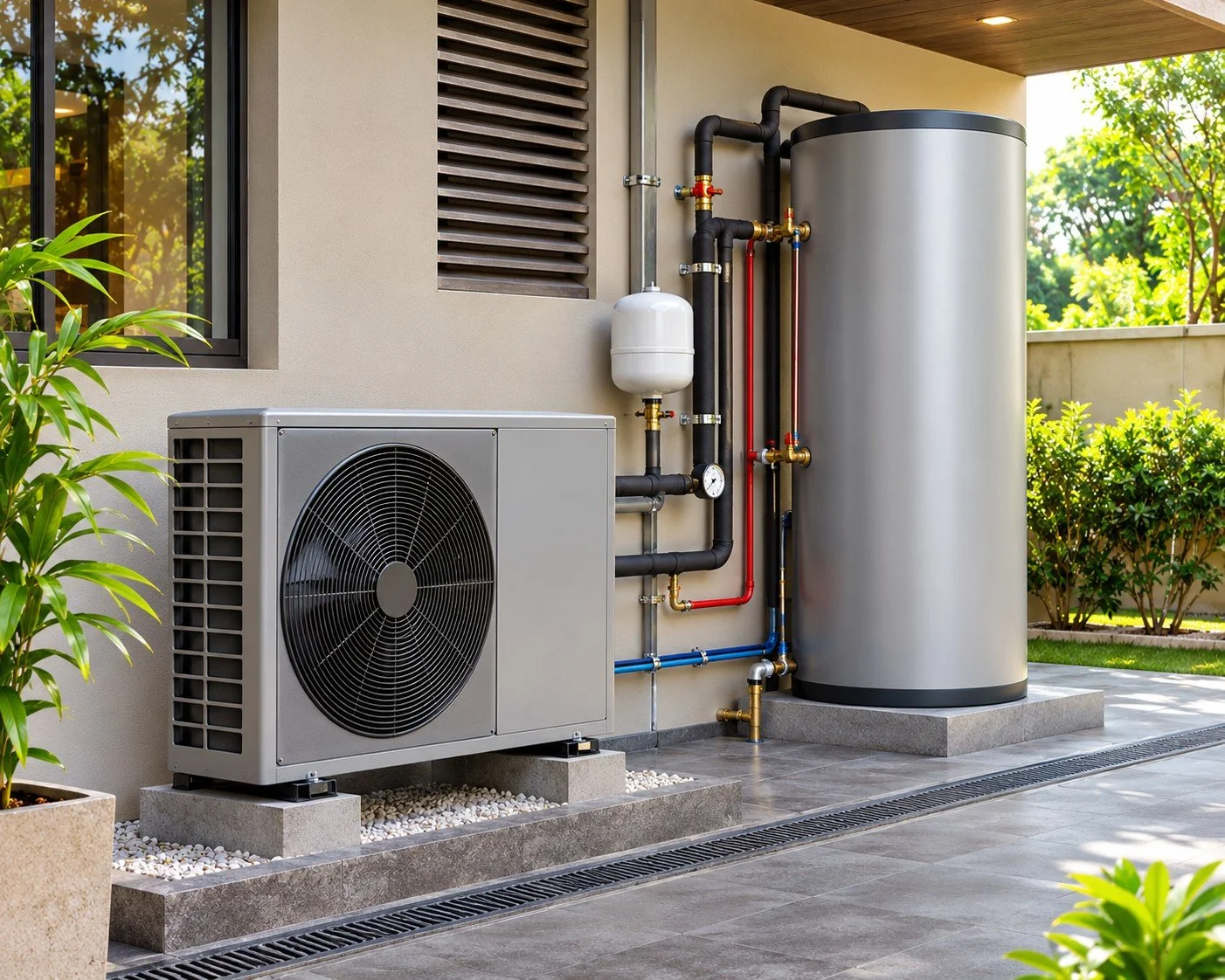
Solar water heaters use solar energy to heat water.
They may reduce electricity consumption when sunlight and demand are suitably matched.
However, cloudy weather, seasonal conditions and early-morning requirements may make supplementary heating necessary.
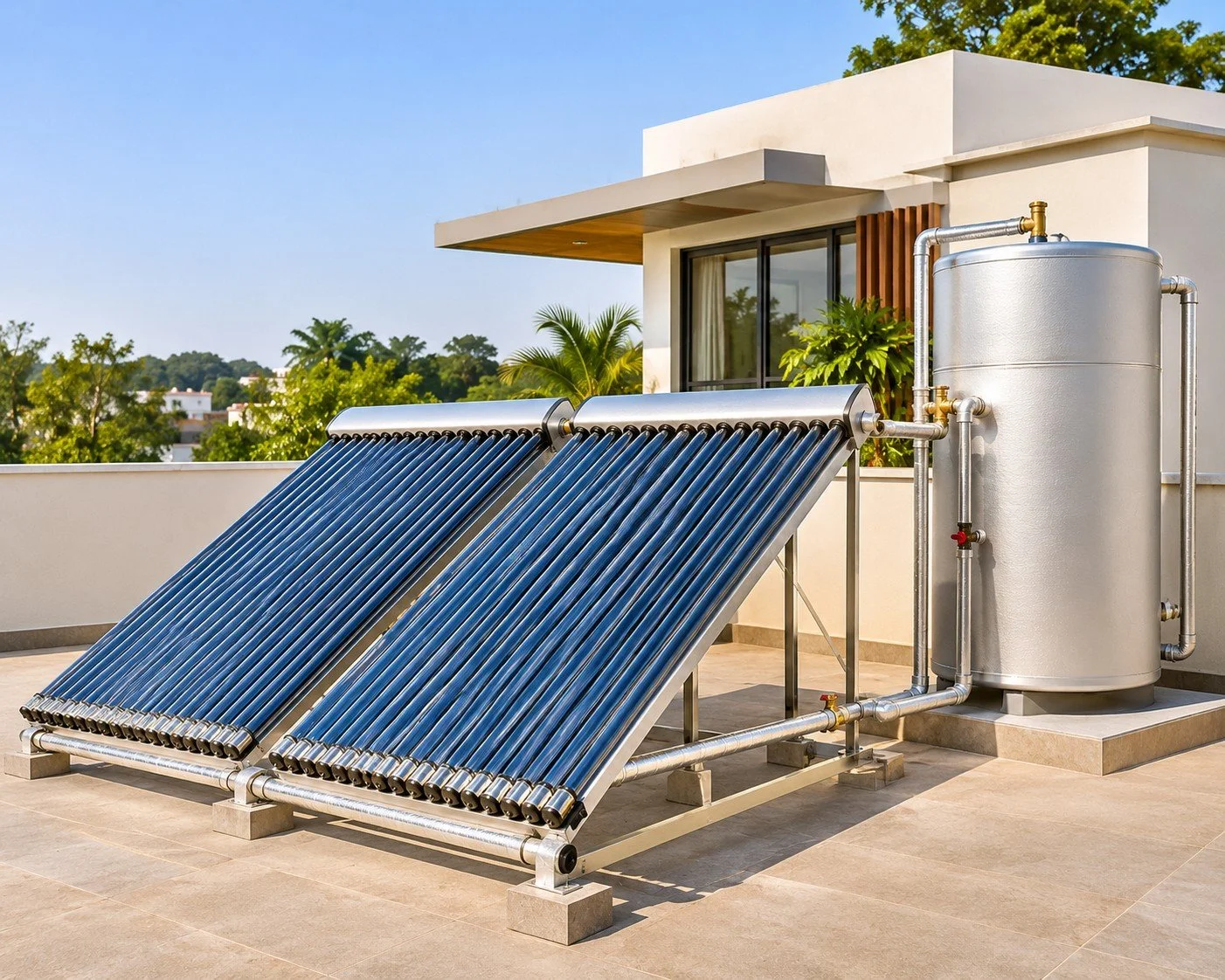
Other heating sources may be technically possible, but their suitability depends on fuel availability, ventilation, safety, regulatory requirements and local servicing.
The homeowner should compare more than initial cost.
Energy consumption, expected usage, installation space, equipment life, maintenance and local service support all influence the long-term decision.
A system that is economical for a large household with frequent bathing may not be economical for a villa occupied by only two people.
7. Comfortable temperature and pressure
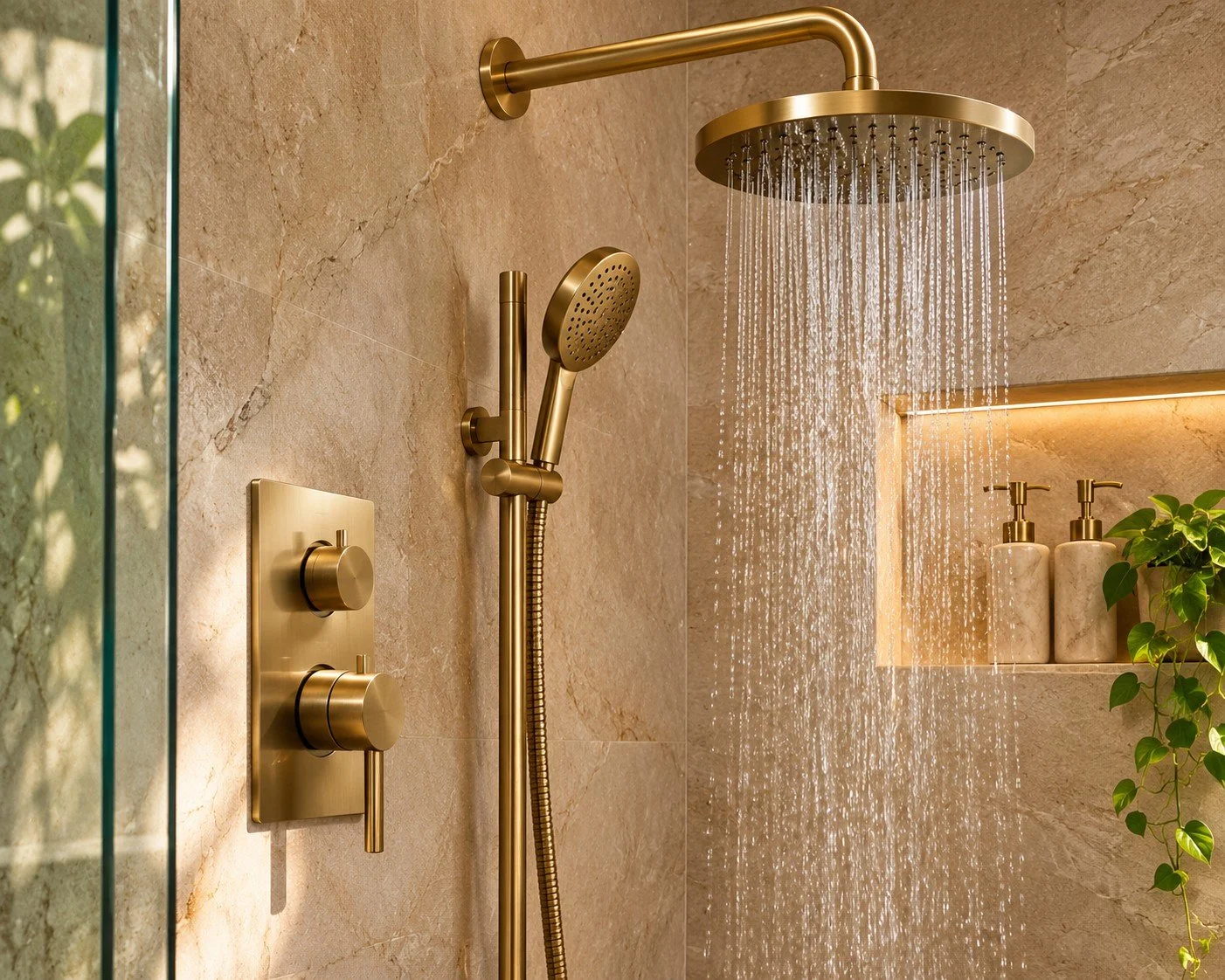
A pleasant shower depends on more than having hot water.
The water must arrive at a suitable temperature and pressure.
Sudden changes can make bathing uncomfortable and, in some circumstances, dangerous.
Very hot water can cause scalding, particularly for children, older people and those with reduced sensitivity or mobility.
Appropriate thermostatic mixing or temperature-limiting arrangements can help control the temperature delivered to fixtures.
These should be selected and installed by competent professionals.
The system must also account for pressure differences between hot and cold supplies.
A shower mixer may perform poorly if the two supplies are unsuitable for the fitting or fluctuate significantly.
For multistorey villas, pressure management should be coordinated with the cold-water system discussed in Chapter 6.
Hot-water storage temperatures, circulation temperatures and temperatures delivered at taps are related but not necessarily identical.
The designer must balance hygiene requirements, equipment specifications, energy use and scald prevention.
The homeowner should not attempt to resolve these competing requirements simply by turning the heater thermostat down without understanding the system.
A luxurious shower is one that feels comfortable, predictable and safe every day.
8. Waiting for hot water
Imagine turning on the shower in a second-floor bathroom.
The water is cold.
You wait.
After some time, it becomes lukewarm.
Eventually, hot water arrives.
This delay may be caused by the distance between the heater and the bathroom.
The water already sitting in the pipe has cooled, and it must leave the outlet before newly heated water arrives.
In a large villa, long pipe runs can waste both time and water.
One solution is to locate heaters closer to the fixtures they serve.
Another is to plan the plumbing routes carefully so that unnecessary distances are avoided.
Centralised systems may use a hot-water circulation loop to keep heated water available nearer to distant outlets.
However, continuous circulation can consume energy through pump operation and heat loss.
Appropriate pipe insulation and carefully designed controls, timers or demand-based operation can help manage these losses.
Circulation systems also require attention to water hygiene, temperature management and maintenance.
The designer should consider whether the improved convenience justifies the additional complexity.
The objective is not necessarily instant hot water at every outlet.
It is to provide a reasonable waiting time without excessive water and energy waste.
9. Hot water in kitchens and utility areas
Bathrooms are not the only spaces that may need hot water.
A kitchen may use it for cleaning utensils and washing.
A utility room may require hot water for certain household activities or appliances.
However, not every washing machine or dishwasher requires a separate hot-water connection.
Many appliances heat their own water or are designed for a particular inlet arrangement.
The homeowner should check the manufacturer's requirements before providing additional connections.
Where a kitchen is far from the main hot-water system, a long pipe run may be inefficient.
A suitable local heater may sometimes be more practical.
The choice should consider actual usage, available space, electrical requirements and maintenance access.
Kitchen and utility hot-water arrangements should be planned alongside the cold-water distribution and drainage systems.
10. Safe installation and equipment location
Water heaters combine heat, water, pressure and, in many cases, electricity.
Their installation requires appropriate safety provisions.
Electric geysers need suitable electrical circuits, protective devices, earthing and isolation arrangements.
Storage water heaters also require manufacturer-specified temperature and pressure protection.
Safety relief outlets and discharge arrangements must be installed correctly and must never be blocked or casually altered.
Centralised systems may require expansion provisions, pressure controls and other protective equipment.
The exact arrangements depend on the equipment and system design.
Heaters should be positioned where they can be inspected, serviced and replaced.
An appliance concealed permanently above an expensive false ceiling may become a major inconvenience when it develops a leak.
Likewise, a large storage cylinder installed in a cramped room may be difficult to remove later.
Heat-pump equipment may have airflow, drainage and acoustic requirements.
Any combustion-based heater must comply with applicable ventilation, exhaust and safety requirements; it should not be placed in an unsuitable enclosed space.
The homeowner should insist on safe, serviceable installation rather than treating equipment location as an afterthought.
11. Water quality and equipment life
The water entering a heater affects its performance and lifespan.
Hard water can contribute to mineral scale formation.
Scale may reduce heating efficiency, restrict flow or interfere with certain components.
Water chemistry can also influence corrosion, depending on the equipment materials and operating conditions.
These issues should be assessed using actual water-quality information.
Chapter 6 explains why testing should precede treatment selection.
A water softener or another treatment system may be appropriate in some homes, but treatment should not be chosen without considering the heater manufacturer's requirements.
Poorly selected or poorly maintained treatment can introduce its own problems.
The family should follow recommended inspection and servicing schedules.
For storage heaters, relevant checks may include the condition of protective components and sacrificial anodes where fitted, undertaken by qualified service personnel.
A little attention to water quality and routine maintenance can help avoid premature equipment failure.
12. Hot water during power cuts
What happens to hot water when electricity fails?
With an individual electric geyser, heating normally stops when power is unavailable.
Stored hot water may remain usable for a period, depending on the plumbing arrangement, water supply and tank conditions.
A centralised system may also stop heating, while circulation pumps or controls may cease operating.
Solar water-heating systems may continue collecting heat under some conditions, but pumps, controls or auxiliary equipment may depend on electricity.
Heat-pump water heaters also require electrical power.
The homeowner should understand which parts of the system continue operating during an outage.
It may be unnecessary or impractical to connect every water heater to household backup power.
Water heating can impose substantial electrical demand.
If backup hot water is an important requirement, the designer should evaluate it explicitly rather than assume the inverter can support it.
For most households, a sensible strategy may prioritise lighting, communication, fans and other essential services, as discussed in Chapter 5.
The hot-water plan should fit within the overall household resilience strategy.
13. Plan, Maintain, Repair, Replace
PLAN
Assess household bathing patterns, simultaneous demand and fixture locations. Compare individual, centralised and hybrid systems. Coordinate heater placement, pipe routes, pressure, temperature control, electrical requirements and safe access before construction finishes.
MAINTAIN
Follow manufacturer-recommended servicing schedules. Inspect relevant safety components, check for leaks, monitor heating performance and address scaling or corrosion concerns through qualified professionals.
REPAIR
Provide accessible electrical and water isolation arrangements. Ensure valves, pumps, heaters and controls can be inspected and repaired without unnecessary damage to bathroom finishes or disruption to the entire home.
REPLACE
Allow adequate space for removing geysers, storage cylinders and other equipment. Retain model details, installation drawings and service records. Confirm compatibility before replacing equipment with a different type or capacity.
A hot-water system should be designed for years of ordinary use, not merely for the day the bathroom is completed.
Heating elements, valves, pumps, controls and storage tanks can eventually require repair or replacement.
These possibilities should be considered before expensive finishes conceal the equipment.
The best long-term arrangement is one that remains manageable after the original installation team has left.
14. Ready reference — Homeowner's hot-water planning checklist
Review these questions with your architect, plumbing designer, electrical designer and hot-water equipment supplier before approving the installation.
Family needs and system selection
Comfort and safety
Maintenance and reliability
15. A final thought
A comfortable bathroom is not defined only by marble, fittings or an impressive shower.
Its everyday quality depends on whether hot water arrives reliably, at a suitable temperature and with comfortable pressure.
That requires thoughtful decisions about heating equipment, storage, distribution and maintenance.
Individual geysers may be ideal for one villa.
A centralised system may suit another.
A carefully planned combination may offer the right balance for a larger family home.
There is no need to choose the most elaborate arrangement simply because the house is luxurious.
True bathing comfort comes from a hot-water system that suits the family, uses energy sensibly and remains safe and dependable over time.
Coming next — Chapter 8: Drainage, Leaks and Conservation. Protecting the villa from hidden water problems while using water responsibly.